Community
No human can live without community. This is true even if our Western culture propagates the illusion of the autonomous individual living freely and consuming without connection to the world. This ever greater coupling of an individual`s care provision to the economic system is leading to increasing dependence upon globalised corporations; social isolation and capitalism are two sides of the same coin.
We are living in a culture of separation – from ourselves and our fellow humans. We live separated from nature, treating it as a source of raw materials, not as our home – a home which we are a part of. That is why what we understand as individuality is often so hollow and has to be proven and maintained with the help of so many external props. In contrast to this stands the interconnected way of life which is still practised in a few places on our planet today by so-called indigenous peoples. There a person lives as part of his or her community, the tribe, and the tribe in turn lives as an integral part of the surrounding nature. We are not advocating a return to such tribal cultures, but we can develop similar but contemporary forms of community which reflect our cultural history. In this way we make a conscious decision to live in community.
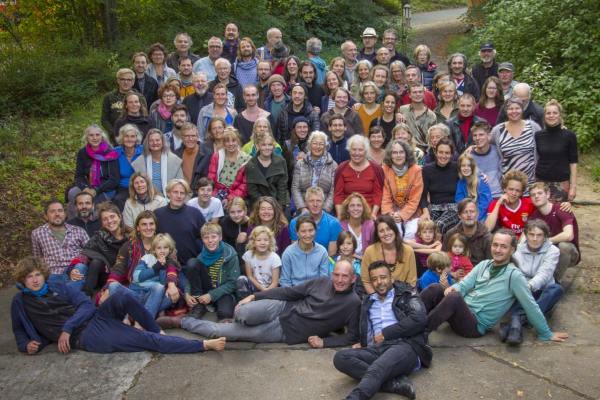
A community is made up of a diversity of people complementing and supporting each other in their growth. Growth means to see and shape our own beings and to take on responsibility which goes beyond our self. This ability to see and know ourself within the human context of Planet Earth grows when we live in community. The social competence and affinity which develop from this are probably the most important abilities which we need in today`s world.
Experience shows that living in community necessitates a few personal changes. Living, working, thinking communally is a demanding process if your emotional base isn`t clear or if important values haven`t been communicated. Ways of behaving which we learnt because of competitive and performance-oriented ways of thinking often get in the way: thoughts such as „I can do it all by myself“, for example. Luckily, the more experience you have of support from and trust in others, the more these thought patterns disappear.
One of our treasures, our competence and our excitement, lies in the many years of experience in building community and in building trust among humans. At the same time we have many questions, times of stagnation and crisis. They are part of our experimental life just as much as the constantly reaffirmed friendship and connectedness which comes from working towards a common goal.
Becoming a member of the community is a process of getting to know each other which might take some years. A community course is obligatory, after which we offer working in the community as a „Saisonnier“ throughout the following summer. At this point a plenary decides whether someone can stay at ZEGG as a community guest. Becoming a member often takes one, two or more years. In this way also the „Newcomer“ is able to thoroughly experience every-day community life. Finally he/she can apply to become a member.