“The times are urgent. Let us slow down.” — Bayo Akomolafe
Climate disruption, war, democratic backsliding, increasing polarization, and an unprecedented sense of loneliness are increasingly shaping the world we live in. Faced with these challenges, many of us dedicate our lives to education, community building, activism, or social innovation — driven by the desire to contribute to a more just, peaceful, and regenerative future.
Yet alongside this commitment, an uncomfortable question continues to accompany us: How can we deconstruct the patterns of behavior and thought that underlie today’s multiple crises — what is often referred to as the polycrisis? Patterns that are embedded not only in our institutions and economic systems, but also within ourselves? What if competition, fear, the need for control, difficulties with trust, or the tendency to distance ourselves from others are not simply characteristics of “the system,” but habits deeply embodied in the way we relate to ourselves, to one another, and to the living world?
This intuition lies at the heart of what Joanna Macy called the “Great Turning”: the profound cultural transition from an industrial growth society toward a life-sustaining civilization.
Such a transformation cannot be achieved through technological innovation or political reform alone. It also requires a different quality of awareness and relationship. If we hope to build communities grounded in cooperation rather than domination, democracy rather than polarization, and peace rather than violence, we need to create spaces in which these qualities can first be experienced and practiced.
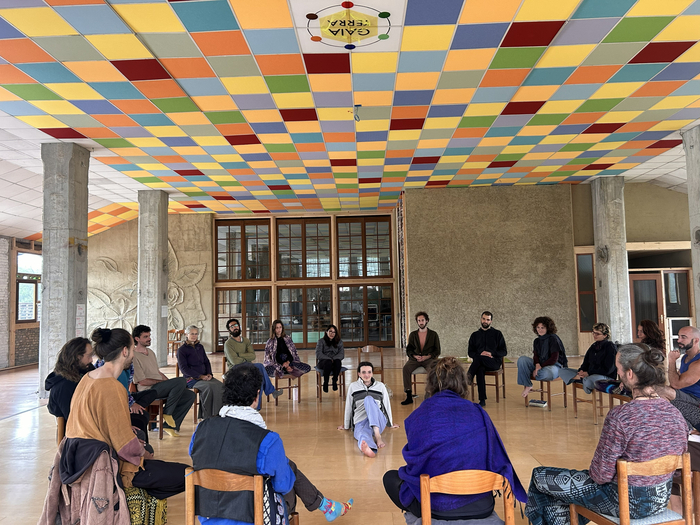
This was the intention behind the ZEGG Forum Foundational Training, which took place at GaiaTerra as part of the Erasmus+ programme. For one week, participants from Italy, Germany, Greece, and Spain came together — not simply to learn a method, but to explore how personal awareness and collective transformation can support one another.
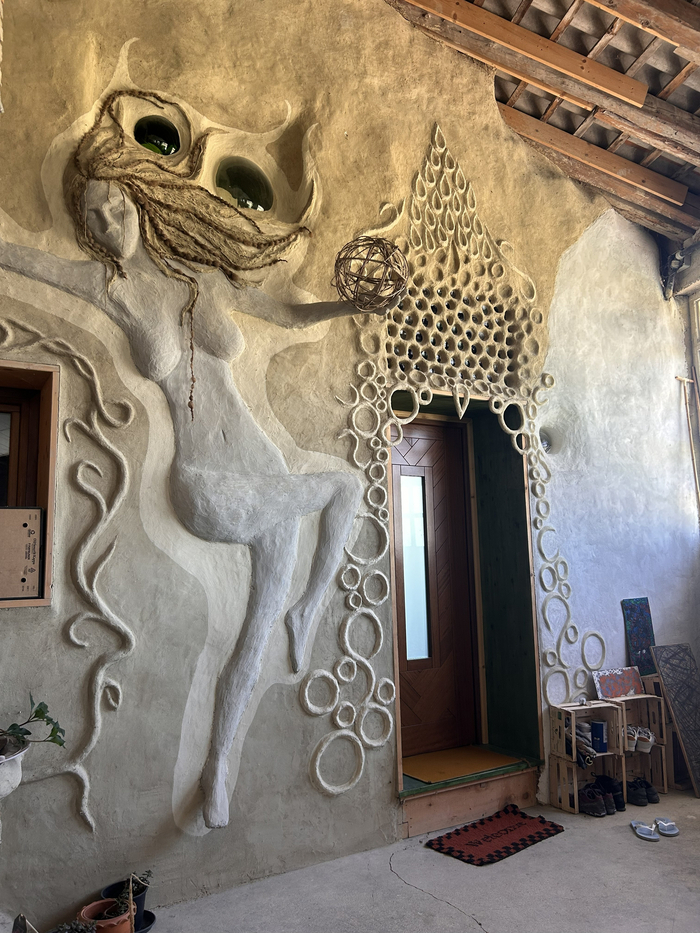
The place itself was also part of the learning process. GaiaTerra is not simply a seminar venue, but a place where an ecovillage culture is lived. Community life here is connected with concrete forms of ecological practice: sustainable agriculture and permaculture, local and vegan food, self-sufficiency, bioarchitecture, the reuse of materials, and projects such as Fervida, which explore natural cycles and a more conscious approach to everyday needs.
During the week, sustainability was therefore not conveyed merely as an idea, but as something shaped through everyday life: in what we eat, build, consume, produce, and share, and in how we relate to our immediate surroundings. The encounter with GaiaTerra made it tangible that transformation does not take place only in workshops, but in the ways people live together, take responsibility, and shape their relationships with the more-than-human world.
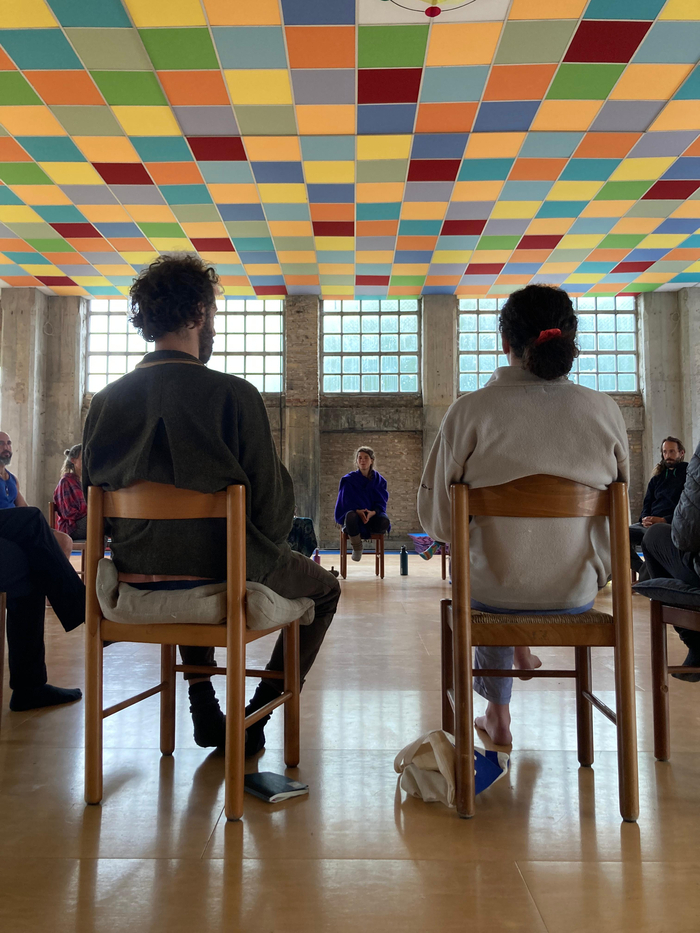
This was precisely what gave the training a particular quality: the ZEGG Forum method, which emerged from the social practice of the ZEGG ecovillage, encountered the culture and context of another ecovillage. Two different experiences of community life came into contact with one another. For Erasmus+ and its aim of connecting people with existing ecovillages and their processes of transformation, this was more than an exchange of methods. Participants were able to experience that social and ecological transformation cannot be separated from one another — and that ecovillages can create spaces in which both dimensions can be explored and lived together.
Against this backdrop, the Forum also took on a particular significance. It was not presented as a technique to be mastered, but as one possible response to a question that concerns everyone who works with people today: How do we create the conditions in which genuine change can become possible?
The programme itself reflected this intention. Rather than immersing participants immediately in Forum practice, the week unfolded as a gradual journey. The first days were devoted to building trust, introducing the principles of the method, and exploring embodied awareness, active listening, feedback, group dynamics, and facilitation.
Gradually, the group developed the psychological safety necessary to approach increasingly deeper processes. It became clear that vulnerability cannot be demanded; it can only be invited.
As the Forum itself moved to the centre of the programme, many participants discovered that beneath its apparent simplicity lies a remarkably demanding social practice.
One person steps into the centre of the circle and brings whatever feels most alive in that moment: a conflict, an emotion, an inner contradiction, an unresolved question, or simply something that wants to be seen and witnessed.
Throughout the process, the facilitator accompanies the person with questions, invitations, and attentive presence. They support the person in staying connected to their experience while gently exploring it further.
When difficult feelings arise, the facilitator supports the participant in remaining present with them — without pushing the process further than feels possible, while also not allowing it to remain merely on the surface.
The rest of the group also has an equally important role. Their task is not to interpret, analyse, or offer solutions, but to attentively witness what is unfolding before them.
Those who sense that something has moved within themselves are invited, at the end of the process, to offer a mirror.
The mirrors are much more than personal feedback. They transform individual experience into a collectively perceptible social reality. What initially appears to be one person’s private fear, shame, longing, or defensiveness becomes visible through the resonance of others as something that can touch all of us. Gradually, a shared sense emerges of which attitudes create connection and which create separation. Truthfulness, vulnerability, self-responsibility, compassion, and openness are therefore not conveyed as rules, but experienced within the social field: one can feel what happens when someone reveals themselves, takes responsibility, or closes themselves off. In this sense, mirrors are deeply culture-forming. They do not merely create awareness for the individual; through repeated resonance, they shape a shared compass of values — a culture in which people can increasingly orient themselves toward what allows trust, aliveness, and genuine connection to emerge between them.
The aim is not to tell someone who they are, but to offer different perspectives through which they can discover aspects of themselves that might otherwise have remained invisible.
Giulia, one of the participants, expressed this beautifully after returning home:
“The facilitators invite the rest of the group to offer a reflection on what they have heard and seen. This mirror is powerful because it is neither a judgement nor a performance, but an opportunity to see oneself through many different perceptions. It is a collective practice of self-exploration that seeks to restore both clarity and complexity — in a world where communication is increasingly confused with opinion, simplistic slogans, and self-presentation.”
Over the course of the days, the group gradually realised that the real subject of the Forum was rarely the individual person in the centre.
Again and again, personal stories revealed collective dynamics: the fear of exclusion, difficulties with authority, the longing for closeness, shame, competition, grief, tenderness, and the need to belong.
The more courageously participants allowed these experiences to become visible, the more they recognised fragments of themselves in one another.
Individual biographies slowly became windows into something larger. They suggested that what often feels uniquely and deeply personal — “mine” — may also be part of the shared human experience.
This process was anything but comfortable.
Exploring our own shadows while being seen by others requires trust, patience, and a willingness to remain in uncertainty.
Many participants were confronted with patterns they had hoped they had long since left behind. They discovered how persistent the inherited ways in which we relate to one another can be.
Yet it is precisely this difficulty that gives the practice its transformative potential.
Rather than seeking to eliminate discomfort, the Forum invites us to stay with it for long enough for something new to emerge.
Matteo, another participant, described this experience in a deeply human way:
“Being seen by a group of kind and generous people who empathise with you and support the world of your feelings and emotions is an incredible tool for personal growth … When they see you without masks, no veil remains, and the love the group feels for you becomes more real and visible. To be seen is, in a way, to be loved.”
For Dieter Duhm, co-founder of ZEGG, this kind of work was never separate from questions of peace and social transformation. He wrote:
“Violence is the eruption of blocked life energies. (…) True pacifism is the radical and intelligent commitment of human beings to the liberation of all life energies and creative forces within us.”
From this perspective, peace is not only a matter of diplomacy or conflict resolution. It is also the patient work of recognising those inner dynamics that, when they remain unconscious, continue to generate violence in our relationships, our organisations, and our societies.
Working with emotions, communication, and community therefore becomes neither an escape from political reality nor a purely personal undertaking.
It becomes part of the long-term cultural work necessary to nurture what Joanna Macy called the “Great Turning”: preparing ourselves to face ecological collapse, democratic fragility, and social fragmentation without reproducing the same patterns of separation that have contributed to them.
The week ended — as meaningful educational experiences often do — without providing definitive answers.
What remained was perhaps something more valuable: a renewed sense that transformation is neither an individual achievement nor a collective abstraction, but an ongoing movement between the two.
Every time we discover something deeper about ourselves, we also learn something about the communities in which we live.
And every time a community learns to witness its members with loving presence, it creates the conditions for each individual to become a little freer and more self-determined in living their own truth.
Perhaps this is one of the quietest — and at the same time most radical — forms of peace work we can practice today.
Davide Scotti