A Question That Remains
This text emerged from a concrete experience.
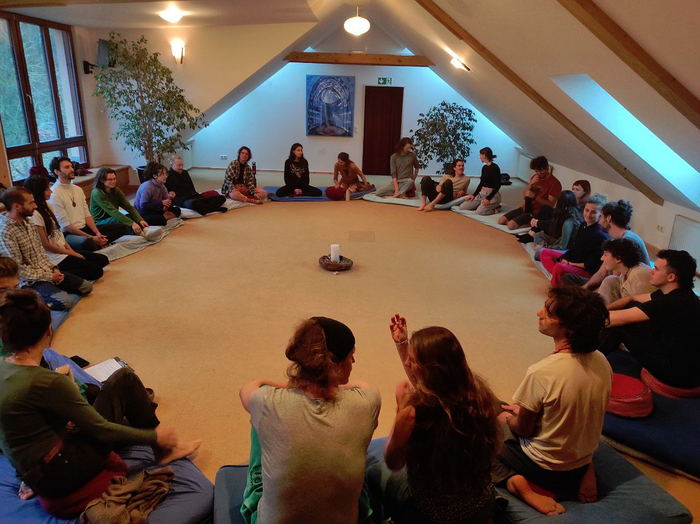
After our ZEGG Forum Foundational Training in Italy, something happened in which a boundary was crossed and sufficient consent was not sought. It stirred a great deal — among those directly involved, within our team, and beyond. Personal experiences were touched, as well as larger collective themes around power, gender and patriarchal conditioning.
We tried to meet what had happened on different levels. We spoke with the person who had crossed the boundary. He took responsibility, apologized, and entered into a deep process of reflection. We stayed in conversation with those affected, held the process within the community, and made space for the collective voices and themes that had been activated. There were apologies — personally and within the larger group — and many conversations about what might be needed for trust and relationship to become possible again.
In the months that followed, I remained in contact with the different people involved. I also offered my therapeutic knowledge and experience to create space for the personal experiences and wounds that had been touched by what happened, and to support their integration.
And yet, peace has not emerged for everyone.
One person, who was not present when the incident occurred, remains deeply in conflict with what happened and holds the position that the person who crossed the boundary should be condemned and excluded from the community.
This is where it becomes difficult for me. Not because I want to minimize the boundary that was crossed. But because I find myself asking whether condemnation and exclusion are really what we mean when we speak about peace work. For me, there is a danger that they continue a dynamic of separation and opposition — a kind of war energy that we are ultimately trying to move beyond.
At the same time, I believe that people can take responsibility, learn, and change. This is why I also supported the possibility of renewed contact between those directly involved, creating space for another encounter.
The following text emerged from this tension. Not as a finished answer, but as an attempt to look more closely:
What does peace ask of us when harm has occurred?
We Need to Learn How to Stay With Conflict
There is a dynamic in today’s social conflicts that increasingly unsettles me. The moment someone crosses a boundary, causes harm, or abuses power, it often seems that only one question remains: Which side are you on?
The patterns of reaction have become remarkably predictable. On one side, minimization, defensiveness, and denial. On the other, moral certainty, condemnation, and exclusion. And between these two poles, less and less space remains.
Yet that space may be precisely what matters most.
Of course, boundaries must be named. Harmful behavior must have consequences. Those who hold power carry responsibility. Those who hurt others cannot be protected by silence or false loyalty.
But what happens when accountability becomes moral totality? When we move from “What you did was wrong” to “You are wrong”?
Perhaps this is why conflicts escalate so quickly. A concrete event is often charged with much larger histories of powerlessness, sexism, violence, exclusion, and trauma. Individual people become carriers of collective wounds. This can make the intensity of a reaction understandable — without necessarily making every reaction constructive.
A society that can only distinguish between perpetrators and the righteous eventually loses some of its capacity for transformation.
From Blame to Accountability
The question is therefore not whether harm should be named. It is whether we can demand accountability without destroying the possibility of human transformation.
Accountability begins with recognizing the impact of one’s actions. With listening without immediately becoming defensive. With taking another person’s pain seriously. With being willing to understand what happened and what needs to change.
But accountability is not the same as permanent condemnation.
People are responsible for their actions and for the impact they have. At the same time, a present conflict may activate experiences that reach far beyond the concrete event itself — personal histories as well as collective wounds.
This does not excuse harmful behavior. But it asks us to hold two truths at once: the harm is real, and the whole depth of what is activated may not originate in the present moment.
This distinction matters because otherwise the person who caused harm can become the container for everything that has ever been hurt.
The Collective Dimension
We do not act in a vacuum. Power, gender, patriarchy, exclusion, and violence are not only individual phenomena; they are also cultural patterns that are transmitted across generations.
This means that conflicts can reveal something larger than the individuals involved.
Perhaps the more difficult question is therefore not only:
Who is the bad person?
But also:
What collective dynamic is revealing itself through us here?
That question does not weaken accountability. Perhaps it deepens it.
Because if we understand harmful behavior only as an individual failure, we may punish the person without examining the culture that helped produce the pattern in the first place.
At the same time, if every individual action becomes merely an expression of collective trauma, individual responsibility disappears.
Peace work may require us to hold both.
Staying in Relationship
This is where peace becomes more than the absence of conflict.
Peace does not mean harmony, and it does not mean that every conflict must be resolved through reconciliation. Sometimes boundaries are necessary. Sometimes distance is necessary. There are situations in which a relationship cannot or should not continue.
But beyond the question of what happens between two people lies another question: What kind of culture are we creating through the way we respond to conflict?
We are not isolated individuals who simply make independent choices. We are social and cultural beings. We grow up within systems of meaning, relationships, gender roles, power structures, family histories and collective narratives. They shape us long before we become conscious of them.
And we carry them into the way we relate to one another.
We can reproduce patterns we consciously reject. We can carry patriarchal ideas while believing ourselves to be free of them. We can participate in dynamics of exclusion, shame, domination or silence without intending to do so.
This does not make us less responsible. It makes responsibility more complex.
Perhaps cultural change therefore begins with the willingness to look inward: to become aware of the biographical and cultural patterns that have shaped us, to recognize where they live in our own behavior, and to take responsibility for what we reproduce through our actions.
If we want to create a different culture, it cannot only happen through changing structures outside of ourselves. It also asks for inner work.
The question is not only what kind of society we want to live in. It is also: What do we carry within ourselves that contributes to creating the society we have? And what would it take to live differently?
The Possibility of Forgiveness
Perhaps this is also where the question of forgiveness becomes relevant.
Not forgiveness as absolution. Not as a demand placed upon those who have been harmed. And not as a way of making something disappear that should remain visible.
Rather, perhaps forgiveness begins with the possibility that a person can be more than the worst thing they have done.
This does not mean that trust automatically returns. It does not mean that every relationship has to continue. And it does not remove consequences.
But if we believe that people are shaped by their histories, their relationships and their culture, then we also have to leave room for the possibility that they can become conscious of those patterns and change them.
That, too, is part of accountability.
Perhaps the question of peace work is therefore not how we avoid conflict, but what we do once conflict has arrived.
Can we name harm without denying complexity?
Can we protect those who have been hurt without making exclusion the only language of accountability?
Can we take responsibility not only for what we have consciously chosen, but also for the patterns we have inherited and continue to reproduce?
And can we create forms of relationship in which responsibility does not end with shame, but can become the beginning of change?
We may not have answers to all of this.
But perhaps peace begins precisely here: not in the absence of conflict, but in our capacity to meet conflict without reproducing the very patterns of separation, domination and dehumanization that we say we want to overcome.