

A Brazilian couple, Débora Nunes and Emerson Sales, who have spent several years traveling to communities around the world recently visited ZEGG. They have summarized their experiences from their travels in the following article. They describe in particular the alternatives to social models that the various communities have developed. Many are based on similar principles (ecological, solidarity, etc.), but have developed special and interesting ways of implementing them. An article for anyone interested in communities as models for the future.
Back home, we would like to express our deepest gratitude to the laboratories of the new humanity that we are getting to know in this project, “Visiting the New World.” We have seen a myriad of innovations in everyday life that point to another perspective of society: communal, ecological, egalitarian, democratic, and more connected to the sacred. In this text, we will briefly discuss these innovations seen in almost fifty eco-places that we have visited in almost twenty countries. We feel the need to thank the courage that led these inspired people to create and continue the dreams that allowed these places to exist. Restless and courageous people who, for years or decades, decided that they could create a new society on a demonstrative scale and have dedicated themselves to this persistently. Gratitude for the hope you spread!
These people moved away from critically analyzing the world as it is, from complaining, and decided to build, as Mahatma Gandhi suggested, what they wanted to see in the world. Taking responsibility, rolling up your sleeves, and doing things with your own hands is a rare adult attitude in this adolescent world, where the responsibility for change is always placed on others. Taking on the task of building dreams collectively is another rare choice in the face of a society where it's every man for himself, where the pursuit of individual success is paramount, and where people find it increasingly difficult to live together, as families, as couples, as groups. The communities we visited go against the tide of consumerism, competition, concentration of power, and alienation on a daily basis, and for this they are admirable.
These experiences contrast sharply with the position of people who criticize the “system,” the elites, life as it is, but remain complacent, as if there were nothing they could do, even in their personal and family lives. The world is falling apart on many fronts, but most people continue to live in old ways, totally inadequate for the necessary healing. There are also those who criticize and roll up their sleeves in the political struggle against what they disagree with, and these people are valuable. But those we are meeting throughout this project go further, they feel in their guts the call to build something new, they carry a different energy within them, they are sacred seeds sprouting and offering a better future for all of humanity.
Because we know of so many similar initiatives that fell by the wayside, giving up in the face of the Herculean task they set themselves—to make the world a better place here and now—we see the persistence of those who continue to build their dream as heroic courage. Persistence requires honesty and deep humility to face mistakes and failures without denying them. Seeking to correct them. At the same time, persistence requires immense confidence in oneself and in the community to face external and internal pressures without giving up. Living this paradox of humility/self-confidence is neither easy nor common; it is proof of great personal value. We are here to reinforce our deep gratitude for your willingness to expose yourselves, often throughout your entire lives, with open hearts, to the challenge of questioning yourselves daily about the dream you are building. And to reinvent yourselves and keep trying.
Something that stands out in the experiences we have encountered is authenticity. In contrast to the old world that values success so much that it falsifies grandiose achievements, displays fake smiles, incorporates false nails and eyelashes and fake black hair, shows disproportionate muscles and feigned joy, your honesty is a balm. In every deep conversation we had, in every interview we did, we felt the authenticity and could see around us the truth of what they told us. The honesty of the communities in building their dreams was always on par with the impulses that originated in these places: living without pretending, looking at oneself with courage, avoiding the comfortable masks. And a continuous desire to walk further in order to adjust, correct, improve. In contrast to these choices and the fake world that surrounds us, your achievements take on even greater stature.
Special thanks must be given to you for advancing democratic practices in everyday life. There is a lot of invention, trial and error in this field, in a profusion of experiments in which sociocracy stands out. While in the supposedly democratic world politics succumbs to the power of money, governments lose themselves in electoral expediency, and democratic convictions are lost in resentment and xenophobia, the communities we visit are committed to a vibrant and inclusive democracy. You are advancing in the study of other forms of inequality that hinder power sharing, beyond the most common ones, economic and educational. And you ask yourselves: Does gender confer privileges? Age? Nationality? The ability to express oneself orally? These are more subtle sources of inequality that we seek to combat so that power and responsibility go hand in hand and power is a service, much more than a privilege.
For us, you are building the participatory democracy of tomorrow, one that is competent, effective, inclusive, and inspires new communities and cities that take on the challenge of citizen participation. We have seen that this issue is often a source of frustration and feelings of powerlessness due to collective and personal incompetence, but note that a healthy democracy is a very ambitious goal and one that remains unachieved in human history. Time must take its course, and generations must follow one another in continuous improvement in order to reach a stage where people are truly satisfied with the democracy they experience. There are so many millennia of authoritarian life to overcome, so many obstacles to equal power, so much pain to heal... You are already doing what you can.
This text was motivated by the desire to express gratitude and briefly recount some of what we saw, but also by the repeated observation that when you compared the original community project with the reality experienced, there was always a certain disappointment. In the face of the advance of retrograde ideologies and abusive projects against civility represented by the extreme right, celebrating alternative communities means reinforcing a humanistic and generous political field that honors the tradition of the left. We imagine that for you, as Eduardo Galeano says, utopia is always ahead, it is a line on the horizon that you want to reach. And perhaps because you are always working and accomplishing and seeing the line of desire further ahead, at times you may have lost sight of the broader perspective of all that has already been achieved. Even in the case of more recent experiences, the intensity of dedication and the immense difficulties faced can dilute the dimension of celebration. That is why we said where we went: the most beautiful achievement is continuity. It is persistence in the dream that gives concrete hope; it is what shows the way.
For all these reasons, we propose viewing intentional communities more than ever as research laboratories. How were the great discoveries made that freed humanity from physical pain and deadly diseases, for example? In laboratories, where people searched, persisted, faced mistakes with courage, and nurtured the flame of hope with small advances that led, in the long run, to great achievements. You are laboratories seeking to heal the human heart and soul. With healthy minds and bodies through a simple and purposeful life, healthy habits, and natural and ancestral treatments, you go deeper in seeking to create solutions for the pains of the heart caused by problematic human relationships. For the pains of the soul, you seek to reestablish connections with the Sacred, beyond religions, which have betrayed themselves so much throughout history. Without dogmas, you appeal to the help of Mother Nature, of Mystery, because you know that denying this dimension of Life is a folly of modernity.
Given the great diversity of what we saw, we witnessed the spirit of experimentation, of practical research, of allowing oneself to be a guinea pig in a collective experiment. As in laboratories, where theories are often not fully proven in practice, there is always a desire to reinvent oneself with each mistake, to review one's initial point of view, to seek to evolve along with the dream that is being built. With each discovery of contradictions, with each confrontation of misconceptions, these communities sought and seek to adjust their pace. With courage and humility, you expose yourselves to discussions in circles, in forums, in infinite ways of confronting each other, knowing that others are mirrors of your own contradictions. You bare yourselves, you tense up, you suffer, you argue, you forgive each other, and you seek new arrangements.
While humanity immersed in the old world, even the richest and most educated people, try to point to an external enemy and lose themselves in the ultimate insanity of preparing for war, the alternative communities we visit know that the great enemy is internal. Or rather, the great teacher who makes us evolve is within, and they first seek within themselves the sources of discord to find means of healing and harmonization. In the holistic philosophy that these communities nurture, what is inside is outside, and our only governance is over what is inside, over personal and community individualities. And there is creativity to evolve, to remain together, knowing that by healing internally, they heal the world, at least a little bit.
Let there be compassion within each eco-place to watch the world fall apart, self-destruct in climate change, in structural unemployment exacerbated by artificial intelligence, in wars for power and money, in the seduction of authoritarian power. These are pacifist communities that engage in social struggles for the emancipation of the oppressed in general and for the greatly oppressed by the system: Nature and its feminine fiber, the giver of life. Between pacifying and fighting, the holistic, quantum, systemic philosophy is a friend of complexity, and each person who chooses to build a new world is invited at all times to leave their certainties behind and embrace the contradictory, the complex, the unexpected.
And this outside world sometimes views these communities with suspicion and often fights them fiercely. They are subversive examples in every sense of the word, breaking taboos, disturbing people, making them question themselves. And alternative communities defend themselves, but seek opportunities to build bridges with their surroundings. By building alliances with more progressive sectors, with social sectors with whom they have partnerships, they try not to isolate themselves, even with so many differences, even with so much work to do internally. They do not always succeed, and many are criticized for being a “bubble.” Perhaps many are, but let's be fair: balancing authenticity and diplomacy with the old world is a huge challenge. Let those who think they could do this without difficulty cast the first stone...
Many communities today are experiencing a new contradiction that they could hardly have foreseen: the questioning by the younger generations of what was created by the previous one. Time passes, daughters and sons grow up, young people arrive in communities, enchanted by the possibility of experiencing new worlds. The fact that these new generations already live in a different societal universe—and do not have to face the world from scratch—makes them see the contradictions of the older generation even more clearly. And they are even more acute in demanding consistency, deepening the original rebellion, and confronting new contradictions that arise as they move forward. But the gap between generations is not unique to the new world; it has always existed and will continue to exist, as each generation faces new challenges. This is why the ancestral wisdom of indigenous peoples managed discontinuity with rituals that honored old age and, at the same time, the impulse of Life, which always seeks to renew itself.
Nowadays, younger generations can be cruel to older ones, who feel powerless to move forward as young people want them to. Those who have built up infinite confidence in the project, in order to persevere, suffer when they are questioned all the time. Without the mediation of the ritualistic tradition of “rites of passage,” the impulse of the new, which needs to be harnessed by the community to keep the flame of the initial project alive, can become destructive or at least cause a lot of sadness. It is up to the new generation to realize the privilege they have received from the construction of those who came before them, and to know how to wait for their time, maintaining their role of driving the renewal that will inexorably come, but always respecting and revering the previous generation. It is up to the founding generation to understand that the initial dream will only remain alive and with renewed élan if young people feel included and not repelled. And that the shamans, the pajés, be called upon to ritualize the transmission without ruptures, which requires wisdom from both generations.
Summary of what we saw in the “New World”
Culture sustained over time is based on continuity and gradual innovation, and one of the foundations of the tradition that ritualizes the passage is the recognition of the culture built in each community. And how it is grounded in the past, in those who came before and are guardians of the original purpose, which will be renewed in new generations. We would like to highlight here some cultural constants that we saw in these eco-places, which, even though they are incredibly diverse, follow some similar paths. Let's take a tour of a regenerative community that synthesizes everything we saw, as a way of honoring what has been built and of concretely thanking its founders. We hope that this tour of the New World we have seen will serve to encourage people to seek to transform their own surroundings. This is the goal of the entire “Visiting the New World” project. But perhaps a broad view of what has been accomplished can also calm the impatience of youth with the slow changes in the communities in which they live. It would also be wonderful if this text could, in some cases, ease the distress of older people at the impatience of young people who criticize them after such a hard life of trying to get things right...
The first thing you see when approaching an alternative community is the exuberance of Nature. In many cases, after decades of work, the pioneers have transformed a desert into a forest, as in the experience of Auroville (India). What you see everywhere is that biodiversity thrives, forest areas increase, untouched natural areas are established, water multiplies, and the air is pure, even in urban communities, such as in Ecovila Maria (Brazil) or Christiania (Denmark). This is the result of a culture of regeneration, constant in all the ecovillages we visited. The connection with Mother Earth, key to overcoming the great human challenge of protecting Life today, is embraced wholeheartedly, day after day, without hesitation. It is the simple everyday choices of food, consumption, and waste management in communities that sustain the results.
We saw that each ecovillage found its own way to eliminate chemicals that kill the soil and reuse everyday waste to nourish it. Permaculture, or the culture of permanence, so present in Crystal Waters (Australia), which reestablishes cycles and sees the whole, is widely used and encouraged, for example through natural resource management, bioconstruction, the installation of dry toilets, various forms of composting and recycling, and even in the reinterpretation of Amazonian indigenous methods of producing fertile Terra Preta, as in Sítio do Futuro (Brazil). Food production, which is present in all communities on a smaller or larger scale, is done organically and at Chacra Rizoma (Argentina) is the main source of income for participants, or the main glue of the community as at Chant des Cailles (Belgium). Agroforests with varied production of vegetables, fruits, and herbs are very common, as in the charming Ferme du Bec Helloin (France) or Ecovila do Altiplano (Brazil). The latter has also established, as in other cases, a partnership with direct buyers of products, in a system called CSA, Community Supported Agriculture.
In this regeneration of the original biomes, communities have found ways to accumulate and produce more water and purify used water, as in Findhorn (Scotland). They plant, care for, and create incredible lakes, as in Tamera (Portugal), ditches to channel water so that it remains on the land, build reservoirs, and protect springs, as in Flor de Ibez or Angatu (Brasil). Native species are prioritized in reforestation, gardens are planted, as at Instituto Terra (Brazil), and there are gardens everywhere, as at Eco Truly Park (Peru). Like the ancestral peoples we visited (the Mapuche in Argentine Patagonia and the Paiter Suruí in the Brazilian Amazon), the people who have sustained this regeneration in ecovillages realize that Nature is sacred, that we are Nature. This perception is the source of environmental healing (“the future is ancestral, or it will not be,” as Brazilian indigenous author Ayrton Krenak says) and is consistently put into practice by alternative communities. It is up to the youth who enjoy this regenerated environment to commit themselves to expanding and deepening this achievement and spreading it widely throughout the world.
The second major difference between the old individualistic world and alternative communities is the presence of a true sense of community, manifested mainly in collective spaces (for socializing, living, working, culture, food, democracy). In Longo Mai (France), even the economy is shared, and the longevity and deep commitment of the participants to the total sharing of resources is surprising. There are community technical infrastructures, most often built in ways that are much more ecological than traditional ones: energy installations (solar, wind, mini hydroelectric plants, geothermal); dirt or soil-cement roads, interlocking blocks, as in the Cafuringa Ecovillage complex (Brazil); chemical-free water management, such as rainwater harvesting, spring collection, and reservoirs that allow communities to cope with periods of drought, as in the Alto Lindo ecovillage (Brazil). The latest development is the production of ecological fuels, as an emerging process that can free communities from the old world of oil (Auroville - India, and Sítio do Futuro - Brazil).
Communal kitchens and dining rooms are ubiquitous. The overwhelming majority of ecovillages are vegetarian, reflecting their commitment to the environment and compassion for animals. Different forms of kitchen management exist, but in most cases there is a sharing of tasks in which people from the community take turns producing excellent organic food, as in Zegg (Germany), with many self-produced ingredients. The dining rooms are meeting places and social hubs that reinforce the sense of living together, and the high-quality shared food nourishes the soul and lowers everyone's cost of living. It is difficult to highlight just one community kitchen, as they are all impressive, so we will mention the largest one we have seen, in Auroville (India), which can serve up to 2,000 meals a day, and the most picturesque, an open-air kitchen that serves the community of Sainte Camelle (France) in the summer.
Collective production spaces with community-owned tools, equipment, and supplies are very common. The production of goods depends on the economic vocation of the ecovillage: there are various handicrafts, small agro-industries, such as olive oil, cheese, and whole wheat bread, as in Los Portales (Spain); the production of medicines and cosmetics with local inputs, as in Chambalabamba (Ecuador); honey, jams, frozen or dried fruit, as in Permatopia (Denmark); small industries based on metal recycling, as in Songai (Benin); and a wide variety of products for external sale. Production for self-consumption, in addition to food, is very common, as is the recovery of objects. There are carpentry shops for the manufacture and repair of furniture, vehicle workshops (especially bicycles), small metalworking shops, and warehouses for the exchange of used goods. With this collective production, communities seek to be as autonomous as possible, generate income, lower costs, and maintain low consumption.
Art, culture, and education are the third highlight of ecovillages, valuing an aspect that the old world rarely prioritizes in its eagerness to consume material goods. Many communities derive their main source of income from courses related to their ways of life: permaculture, various community governance techniques, bio-construction, alternative therapies, and experiences that integrate many of these techniques. In Glarisseg (Switzerland), there is a well-equipped training facility with large classrooms; in Piracanga (Brazil), there is a beautiful and well-built tropical accommodation park for course participants; and at the Contestado camp, run by the MST (Brazil), there is an international school of agroecology.
The cultural infrastructure draws attention to communities that sometimes have fewer than 100 inhabitants but have space to welcome hundreds of people. This is the case of Fazenda Plenitude (Brazil), Matavenero (Spain), and Chambalabamba (Ecuador), where an open-air theater is the focal point of a community originally made up of artists. Artistic performances, usually free of charge, attract many people from outside in large spaces such as Auroville (India) and Findhorn (Scotland). Art is present in all the ecovillages visited, and in Arca Verde (Brazil), beauty can be seen in everything from the bio-architecture of the residences and collective spaces to the ecovillage's signposts. in Damanhur (Italy), the underground Temple of Humanity impresses with its beauty and grandeur; in El Nagual (Brazil), the mosaic ensemble leaves a joyful mark on the memory. The infrastructure for parties, as in Tamera and Zegg, shows the desire to celebrate life, dance, make room for flirting, and nurture the joy of being together. The music square at Crystal Waters (Australia), with its huge musical instruments available to anyone who wants to play, is another unforgettable memory of the New World, as is the organization of artistic residencies to stimulate art connected with the regeneration of Nature, offered at Terra Una (Brazil).
Low consumption is the fourth feature that makes these visited spaces a “New World.” Consuming little is not linked strictly to financial constraints; it is an ideological choice to seek a happy sobriety that is revealed in spaces, buildings, clothing, among other things. To reduce the community's ecological footprint, that is, the mark that people leave on the world through their lifestyle, various techniques are used. Much of the equipment is collectively owned, and there are services that everyone uses, such as community laundries, public bathrooms and saunas, and the aforementioned dining halls. The exchange of used goods is also constant, and in many ecovillages there are even specific “stores” for this purpose, where items that are rarely used (clothes, appliances, furniture, utensils) are made available in a space maintained by the community so that people in need can go there and take them for free.
The fifth theme that stands out is the culture of femininity and the development of secular spirituality. The ways in which each community seeks to overcome patriarchy are varied: political, artistic, sexual, economic, behavioral, but also spiritual. The fact is that we live in spaces with much more gender equality, where women have their rightful place and where they are generally in the majority and have significant political weight. Masculine gentleness is being built in these experiences as in few other places on Earth, and there men cry, open their hearts, and do not need to have the last word or speak louder. With the primordial sacred forces in a state of greater balance, without Yang dominating Yin, the multiplicity of emotional choices becomes natural. And so non-binary behaviors flourish, as do emotional and sexual experimentation, as in Terramirim (Brazil). This theme, so dear to the younger generations, can develop and far exceed the achievements of previous generations.
This choice for a more inward-looking life, so natural to the Yin force linked to the feminine, means that places for cultivating the sacred are always present. These are usually immersed in Nature, such as the open-air shamanic temple in Cabrum (Portugal), but they can also be spaces with a great visual impact on the community, such as the Matrimandir in Auroville (India) or the “truly” shaped temples in EcoTruly Park. This non-religious, ecumenical, integrative spirituality is a powerful expression of the changing worldview that perceives reality as matter and energy and values the vibratory part of reality, including thoughts, emotions, and the subtle dimension of Life. This same worldview clearly perceives the interdependence between human beings, between them and the rest of Nature, and the unity of everything, gradually learning to perceive the complementarities of opposites, moving away from separateness.
The last topic to comment on, the sixth, is a consequence of everything that has already been described and concerns the pursuit of self-management, the achievement of good collective governance. In all the communities we visited, we witnessed or heard about recent meetings that show a commitment to staying together and evolving together. In communities, there are always co-constructed documents that summarize the project, which have sometimes evolved over decades, reflecting collective history and bearing witness to the effort to be together in a self-managed way. The material infrastructure bears witness to the successful collective investments that have been made over time.
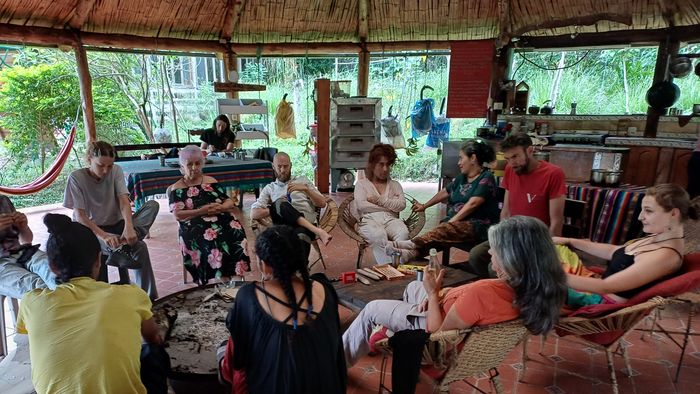
For participatory governance to exist, one of the most important characteristics of the people in these communities must be present: the courage to open oneself up to personal transformation in order to manage conflicts. For this, self-knowledge and the ability to forgive oneself and others are very important. This premise reflects the desire to help the community overcome misunderstandings, impulsive behaviors that can hurt others, egoistic movements... and thus appease seemingly irreconcilable differences and persist in the project. So, if we had to choose just one image to express the New World we visited, it would be the community discussion circle, in the open air, in the kitchen or in an auditorium, in its ritual moments, in voting, or in deep listening to another person. There, the community's destiny is played out, along with the thousands of daily actions that build the achievements we had the pleasure of visiting.
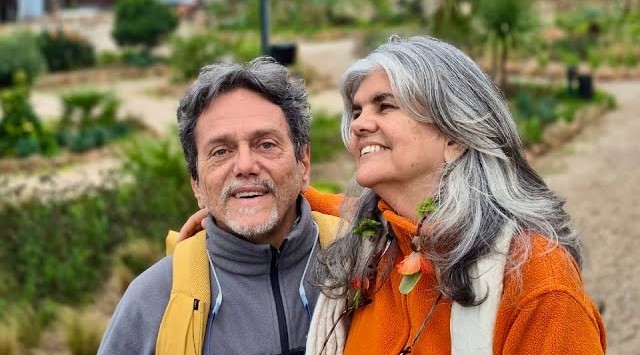
Emerson Sales and Débora Nunes